Move fast, with guardrails
Give teams a sanctioned path to deploy AI while central IT sets access, models, tools and human approval policies.
- Role-based permissions
- Central prompt management
- Encrypted credentials
- Human-in-the-loop controls
Build, govern and deploy AI agents from one platform. Give teams approved prompts, knowledge and workflows, then deliver answers through accessible web embeds, collaboration tools and voice—with every run visible to central IT.
*With managed implementation, across published Gecko deployments.
Trusted by 100+ institutions including
eCampusUniversity System of Georgia
UC Irvine
Lamar University
96%
of student questions answered after deploying its Gecko AI agent.
Read the story ↗
1,081 hours
saved in seven months, while 63% of agent conversations happened out of hours.
Read the story ↗ eCampusUniversity System of Georgia 30,000 studentssupported around the clock by Gecko AI agents.
Read the story ↗
95%+
success rate for its Gecko AI agent after connecting it to live university website content.
Read the story ↗Results are from published Gecko agent case studies. Every institution and use case is different.
Your teams are already experimenting. The challenge is turning scattered enthusiasm into a secure, connected and measurable institutional capability.
Give teams a sanctioned path to deploy AI while central IT sets access, models, tools and human approval policies.
Ground agents in trusted institutional knowledge and let them work across your existing systems, channels and services.
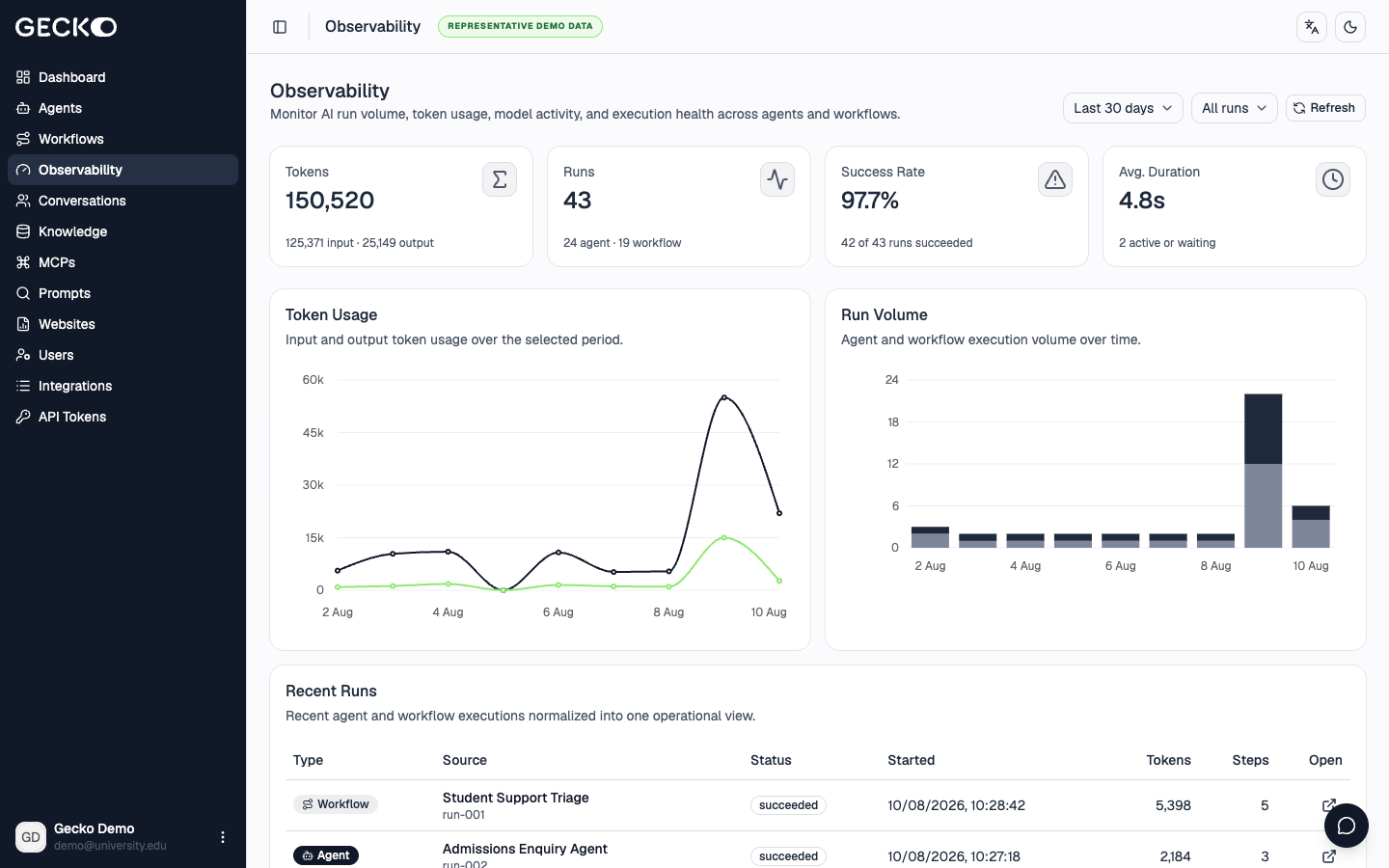
See what ran, what it cost, how long it took and whether it worked—across agents and workflows in one view.
From centrally managed prompts to production agents, Gecko gives technical teams and domain experts a shared place to build responsibly.
Create agents around a centrally managed library of reusable prompts—or describe the outcome in plain English and let the AI builder draft the agent, its workflows and safeguards for your team to review before anything is created.
Bring your first use case →Orchestrate multi-step work with branching, parallel execution, AI calls, code, approvals, authentication and notifications.
Crawl your websites—including JavaScript pages and linked PDFs—ingest SharePoint content, and give every agent access only to the sources it needs, with hybrid vector and full-text retrieval.
Make your SIS agent-ready through Ellucian Ethos, connect Salesforce and your Microsoft estate, and wrap proprietary systems with existing or custom MCP servers—while IT controls exactly which agents can use which tools.
Monitor agent and workflow runs together. Trace every step, model and tool call while tracking usage, duration and outcomes.
Role-based access, scoped API tokens, input guardrails that flag, redact or block risky content, human approval gates and complete run traces turn policy into practical platform controls.
AI creates value when it can act inside a real process—not when it sits in another chat window. Gecko connects reasoning, knowledge, tools and people in one traceable flow.
Deploy the same trusted knowledge, tools and guardrails across digital and voice experiences—without rebuilding the agent for every channel.
Use floating chat, inline conversation or AI search without rebuilding the agent—or letting website styles bleed into it.
Install agents directly into Teams so people can find answers and complete tasks without changing how they work.
Bring governed agents into Slack conversations and channels for fast, contextual help across distributed teams.
An AI receptionist answers your number, routes callers to the right agent—or warm-transfers them to a human team—and agents can make outbound calls too. Every call keeps a transcript.
Build a reusable AI capability for the institution, then let each department apply it to the work that matters most.
Ground a support agent in approved policies, triage requests automatically and route exceptions to the right human team with full context.
Explore this use case →Qualify enquiries, personalise follow-up and coordinate activity across admissions systems while keeping recruiters focused on high-value conversations.
Explore this use case →Connect institutional knowledge and service tools to triage requests, guide users through fixes and create enriched tickets when human support is needed.
Explore this use case →Automate information gathering, content drafting and administrative coordination while preserving expert review at every important decision.
Explore this use case →Use trusted relationship context to prepare outreach, surface opportunities and coordinate follow-up across alumni and development teams.
Explore this use case →Gecko already powers the moments that shape the student journey. If you know us for chatbots, this is the platform they grew up into: vendor-neutral models, open MCP tools, portable workflows and IT-grade governance—built on seven years of higher education AI conversations.
Build on a higher education platform already supporting the student lifecycle:
Choose how you connect, how you consume AI and how your teams work—without compromising the institutional standards IT is responsible for.
Connect any existing MCP solution in your estate, or build your own MCP server to expose approved tools from proprietary systems. Gecko discovers the available tools and lets administrators control exactly which agents can use them.
Use institution-owned provider credentials when that fits your procurement and governance model—so inference runs under agreements you already hold—or use Gecko-managed AI access for a faster path to production. IT curates exactly which models each tenant may use.
Institutional AI shouldn’t be a one-way door. The receipts:
A VPAT supports accessibility review, while a multilingual interface helps teams operate the platform in the languages that work for them.
Architecture, implementation and adoption support from a team that already understands university systems, stakeholders and service expectations.
Plan your first agent →The controls behind the platform, stated plainly—because “trust us” is not an architecture.
Independent regional deployments in Ireland, the United States and Canada—each with its own database, secrets and domain. Website crawling can egress from the UK so content is fetched in the right jurisdiction.
Single sign-on—including SAML—through Gecko’s identity service; the console is SSO-only in production. Role-based access spans 26 resource types with separate read, write and run permissions, so someone can operate an agent they cannot edit.
Integration credentials and secrets are AES-256-GCM encrypted with key-rotation support, and secret values are write-only—never shown again after save, not even to admins. API tokens are stored only as hashes, expire, and can never exceed their creator’s permissions.
30+ built-in detectors screen user input for prompt injection—including invisible-Unicode smuggling and encoded instructions—and sensitive data like national IDs, card numbers and credentials. Each rule can flag, redact or block, and your team can test custom rules in-console.
Workflows pause for approval as interactive cards in Slack or Teams, backed by single-use cryptographic action tokens that cannot be replayed or forged. Email code verification confirms who an agent is talking to, and guardrail hits auto-flag conversations for human review.
Hosted on AWS with SOC 2 and ISO 27001 assurance. A VPAT supports accessibility review—and the platform goes further: web embeds are validated against WCAG 2.2 AA contrast requirements before they can be published at all.
Start with the concerns that determine whether AI becomes an institutional capability or another stalled pilot.
Central teams can control user roles, provider integrations, model access, API tokens and tool permissions. Workflows can require human approval or user authentication before sensitive actions continue, and every run retains a detailed trace.
The platform runs as independent regional deployments in Ireland, the United States and Canada, each with its own database and infrastructure. Gecko does not train AI models on institutional data. When you bring your own provider keys, model inference runs under the data-processing agreement your institution already holds with that provider.
Your existing Gecko Engage products keep working exactly as they do today—and the platform connects to them, so agents can act across Gecko Engage contacts, events, forms and campaigns through a hosted integration. When you’re ready, we’ll help you evolve existing chatbot use cases into governed platform agents on your own timeline.
Gecko provides a central prompt library that teams can organise into folders and manage through role-based read and write permissions. Saved prompts support dynamic variables, dates and conditional logic, and can be reused by agents and workflow AI steps instead of being copied into every implementation.
Yes. Gecko can ground agents in websites and managed knowledge, make your student information system agent-ready through Ellucian Ethos, connect Salesforce, and work with SharePoint, Google Drive, OneDrive, Dropbox and S3. Beyond that, agents act through integrations, APIs, webhooks and MCP—connect existing MCP servers or build your own to give agents controlled access to proprietary systems.
Choose a floating chatbot, a minimal inline conversation or an AI search experience, then add the generated script tag to an approved website. Each interface can use tenant-specific colours, title text and imagery. Shadow DOM style isolation prevents the host website’s CSS from changing the interface, while keyboard, screen reader and reduced-motion patterns support accessibility review.
No. The platform supports OpenAI, Anthropic, Amazon Bedrock, Azure OpenAI, Google and OpenRouter, plus any OpenAI-compatible endpoint your institution approves. You can bring institution-owned API keys or use Gecko-managed access, and swap the model behind a live agent without rebuilding it. Tools use the open MCP standard and workflows export as portable JSON—so your investment travels with you.
Start with a bounded outcome and baseline the current service. Unified observability then shows run volumes, status, duration, token usage, tool calls and errors across agents and workflows. Combine that evidence with enquiry volumes, handling time and cost data to build a value case your finance and service leaders can test.
With Gecko’s managed implementation, a fully operational agent is deployed in less than a week on average. We help define the use case, connect knowledge and tools, establish controls, test behaviour and support go-live.
Yes. Single sign-on—including SAML—is provided through Gecko’s identity service, and the console is SSO-only in production. Role-based access control separates read, write and run permissions across 26 resource types, and API tokens are scoped, expiring, stored only as hashes and can never exceed the permissions of the person who created them.
The platform is hosted on AWS with SOC 2 and ISO 27001 assurance, deployed in independent regional stacks in Ireland, the United States and Canada. Credentials and secrets are AES-256-GCM encrypted, and a VPAT supports accessibility review—with the administrative interface available in English, Welsh and Spanish. A full security pack is available on request.
Start with one bounded process where demand is high, knowledge is trusted and the outcome is measurable. Gecko can help shape that first use case, establish the guardrails and turn what works into a repeatable pattern for other teams.
Bring us one process or service bottleneck. We’ll help you define the outcome, controls and evidence needed to turn it into a governed production agent.